An unscientific survey of capacitance meters available to hobbyists.
Wednesday, March 25, 2026 at 06:35:27
Recently, a forum buddy and I talked about capacitor measurement and devices to do such work. I decided, since I have a number of devices and access to a calibrated measurement device, to check a number of parts to see how well each device matches.
Why are we testing capacitance meters?
Simply put, there are many out there on the market under $100, and I have a number of them. I wanted to both know how these performed, and I told the forum I’d see which one performed the best. Thus, the testing.
Introduction and the devices themselves.
The reference device is an Agilent E4980A. This is a thousands-of-dollars instrument that tells you nearly everything you could need to know about capacitors. It’s calibrated, and has compensated kelvin clips for the measurement end. There are no pictures of this device in situ because, while the facility it’s in says I’m free to use it, they asked that no pictures be taken inside the facility. Sure thing, no prob. You can find pictures of this device online.
For this testing, I wasn’t worried about marked value vs. actual value, although that was recorded for posterity. All of the parts save one is NOS or RFE. These parts were chosen to be representative of the components you would find inside of an older device, especially the kind that typically graces my bench.
Capacitance meters were chosen based on the fact that you can get them, or their re-badged cousins easily at a show or online. Those devices are:
A generic L/C meter from an online shop. No name.
A FNIRSI LC1020E.
A B&K Precision Model 830 Autoranging Capacitance Meter.
A NIU M-Tester from Dayton 2016.
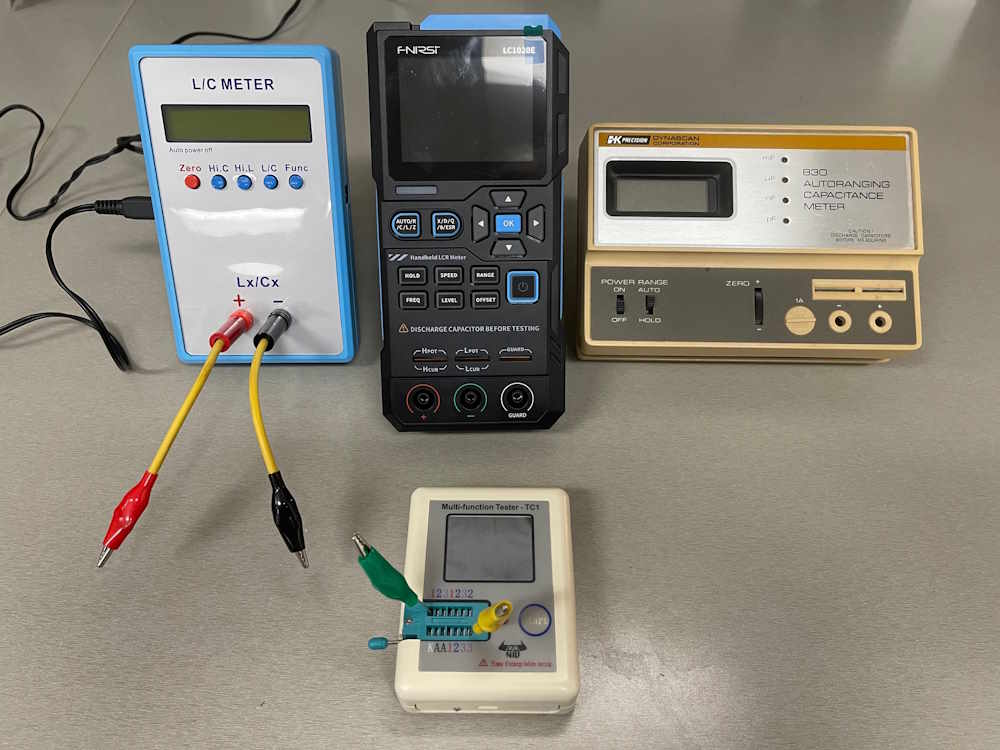
The leads in the picture were used for all devices except the m-tester, which needed the jig clips shown. These were made by me the night before testing using stock from my parts bins.
The parts that we’re testing.
Components were either things I had in storage, things I had bought for projects, or components removed from devices. All save the new one on the top left were suspect, leakage/etc. did not factor in to my testing.
They are, from left to right, top to bottom:
A Supertech wet, 100μF, new.
A GI 50μF dry, NOS.
A Mallory dry, 20μF, RFE
A Good*All wax paper 0.25μF, RFE.
A Bumblebee dry paper, 0.047μF, RFE.
A Solar postage stamp, 100pF, RFE.
A Sangamo Silver Mica dogbone, 1nF, new.
A Aerovox postage stamp, 6300pF, NOS.
A CornellDublier postage stamp, 10000pF, RFE.
A Bumblebee paper in oil, 0.022μF, blue wire lead, RFE. (Leaks oil.)
A Bumblebee paper in oil, 0.022uF, bare wire lead, RFE. (no leaks yet!)
A Sprague wet, 15μF, RFE.
A GI encapsulated paper, 0.033μF, RFE.
New = new part purchased within the last few years.
NOS = an old part, otherwise unused.
RFE = Removed From Equipment.
wet = wet electrolytic
dry = dry electrolytic
The rest should be self explanatory.
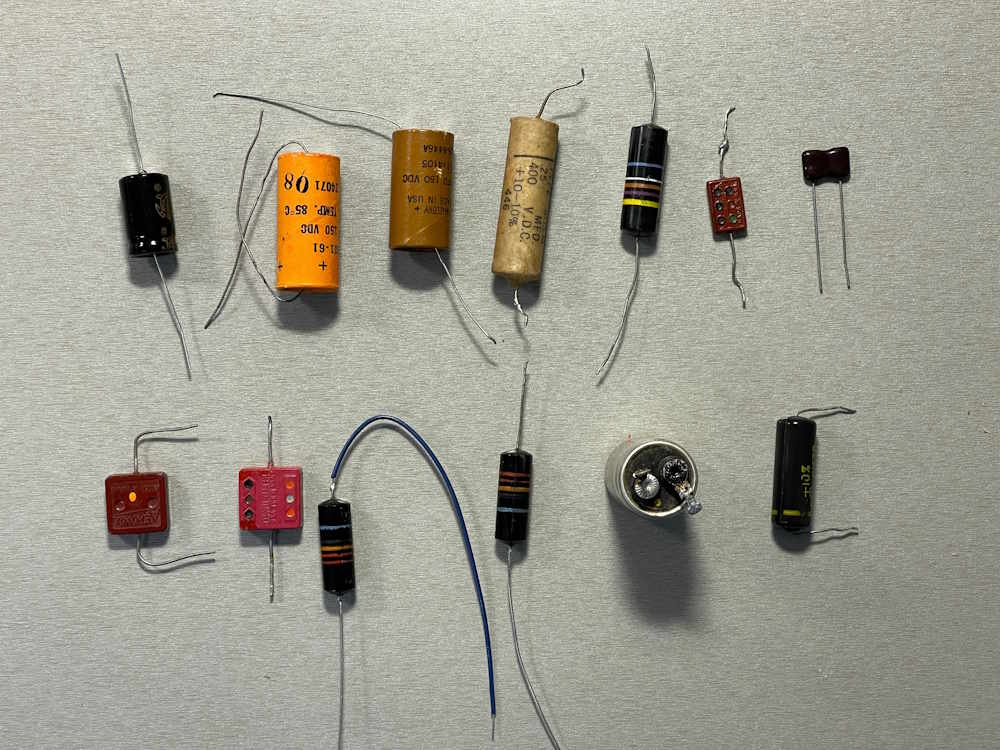
The postage stamps are presumed to be mica, but it’s hard to tell. Paper was packaged that way, so no assumptions are being made to their construction.
The testing methodology and notes.
Testing was simply connecting the unknown, adjusting the frequency (if possible,) and recording the value. Test frequencies used were:
120Hz - All electrolytics
1KHz - All others
The reason for this is these meters use a component of measurement called reactance. This is basically resistance of the part, with a phase angle. Geometry students will know that as a phasor, a complex number with an imaginary √-1 component. This complex number is a resistance value and an angle, -90° for a perfect capacitor.
You can’t measure DC resistance of a capacitor because it holds a static charge on it’s plates, and presents an open to your meter. AC, however, “goes through a capacitor like piss through a tin horn,” according to my first electronics instructor, Mr. Norman. This complex number is why you have a capacitor on motors. Not only does the capacitor help provide a kick to start the motor (the storage capacity of the device,) but the capacitance tries to drag the opposite force of the motor’s inductance back to zero where you only pay for the actual power used, not the power represented by the complex number. It’s basically black magic with some science added for flavor.
Regardless, data was recorded from all devices and compared to the reference unit. I originally thought that the venerable B&K 830 would provide the best measurement, as it was a fairly expensive instrument sold to industry, but that was not the case. I’m assuming this is because it doesn’t change the measurement frequency, but tries to use a best approximation for everything.
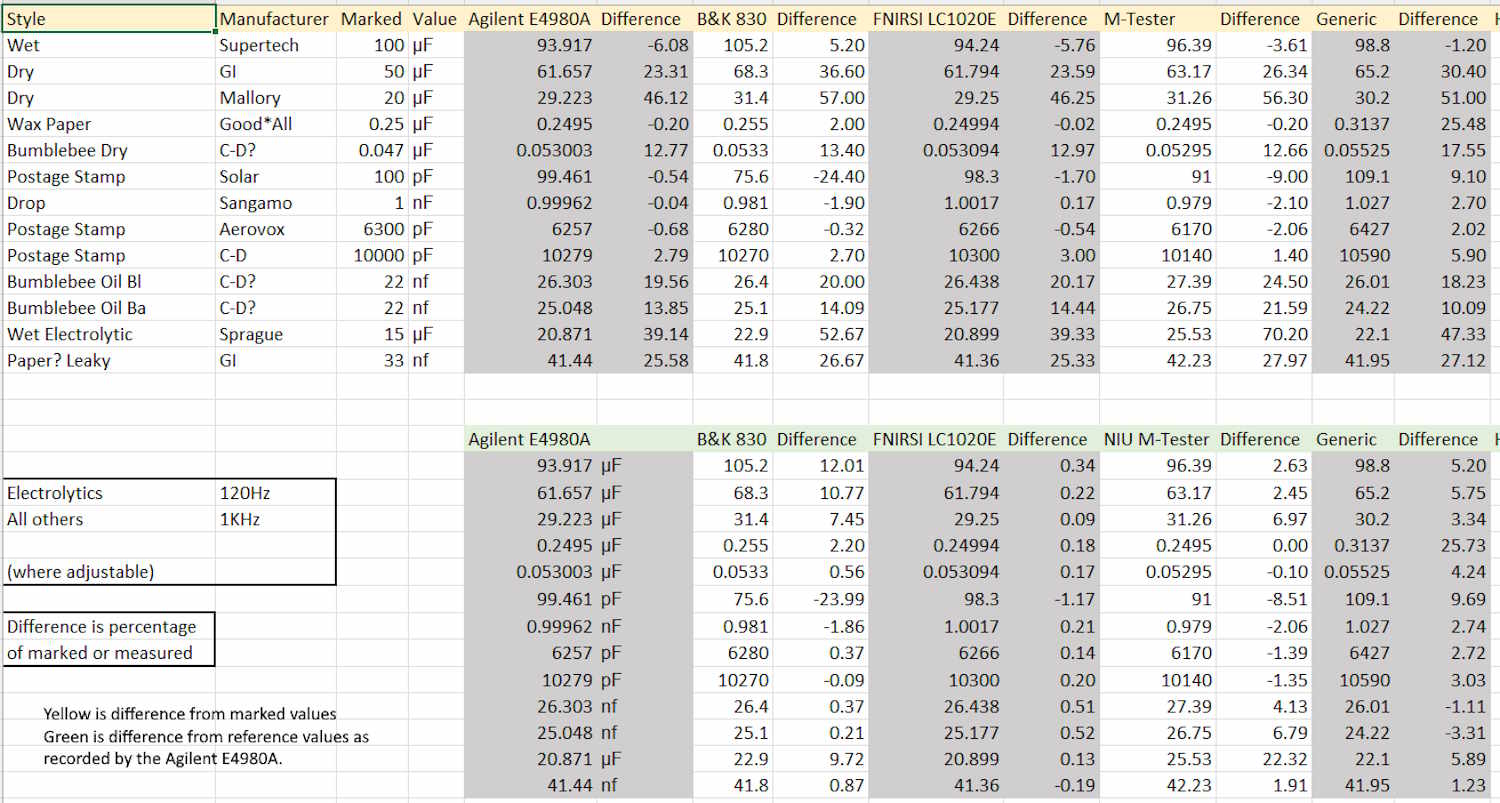
The FNIRSI device, however, came within 0.5% of the Agilent reference except on a very small value part, of which is probably due to capacitance of the leads…1 part in 100 is 1%, so any small deviation is going to show up. It’s far better than you’d need as a hobbyist and shows how far we’ve come in tech. The M-Tester and the B&K 830 kind of went around themselves competing for 2nd place, but the M-Tester offers other component tests and is really good enough for most stuff. It’s a fairly valuable device on my bench.
I realized after the fact that the FNIRSI device came with kelvin clips - I’ll re-run the test at a later date and publish new data.
The blue generic device came in third. It’s not terribly accurate, but it did the job. If you needed something and were working on old equipment, this device would satisfy your needs.
Conclusions.
The FNIRSI LC1020E, at about $80, is a superb value and will get you industrial bench performance at a hobby price. This is without using the compensated clips, so you get an instrument with leads you can reliably expect to provide good data, assuming you can set it up. The device does far more than this, and offers a staggering amount of data on the parts.
The M-Tester is a good, quick way to check all common parts, including common semiconductors. While not as accurate, they’re cheap, good enough, and should be in your travel bag if you do electronics of any sort.
The B&K 830 is meh. These still show up on the secondary market, but really don’t do anything that modern devices can’t. They are fairly rugged and can be powered from the line, so if you need a good-enough device with those parameters this is your man.
The generic one is nah. If you can get one for a couple bucks at a show, sure. It’s good to have a 4th opinion. Otherwise? Pass.