On Soviet and US germanium diodes.
Tuesday, April 14, 2026 at 08:37:14
Germanium diodes are a staple of electronics. It appears as the detector in both radio and television, the tone chain of musical instrument amp, and plenty of other places. This part offers a low voltage drop, low capacitance, and relatively high speed. They used to be cheap and everywhere, and still have plenty of uses - especially for experimenters.
Unfortunately, germanium diodes aren’t common these days, and aren’t made in any great quantities. There’s also the online hysteria surrounding the part, where unscrupulous sellers are more than happy to label a schottky diode as germanium. While these are fine for detectors in radio, they aren’t germanium and if you’re expecting the properties of germanium, you won’t get it.
However…
The USSR made germanium parts right up until the end. There’s still millions of germanium diodes out there from this era, and, while even those are starting to get harder to get, you can still get them relatively easy from online sellers and auction sites. These diodes are perfectly good germanium parts, and came in many different styles and ratings. For most experimental purposes, there’s no difference between parts, and this isn’t going to discuss that. There is, however, a singular difference between Western and Soviet parts.
Here’s an old GE 1N60 diode. This image came from…the Internet. Somewhere, I’m sorry I don’t remember where.
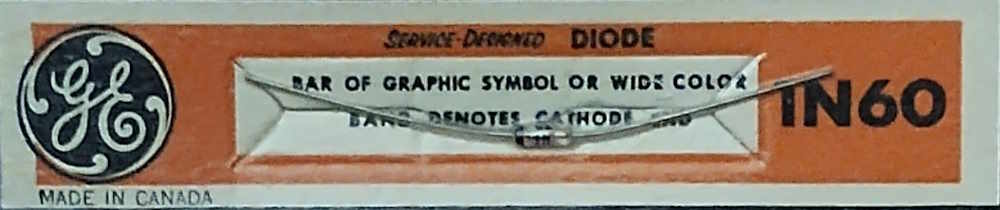
Note that the package states the cathode, i.e. negative-most terminal, is denoted by the band, or the bar on the graphic symbol (the diode symbol) printed on the glass. In this case, the cathode is pointed towards the left. This is the way Western diodes are marked, and is the way pretty much every diode made today is marked. There are some exceptions, but there’s almost always some identifier to indicate what’s what.
Here’s a bunch of diodes.
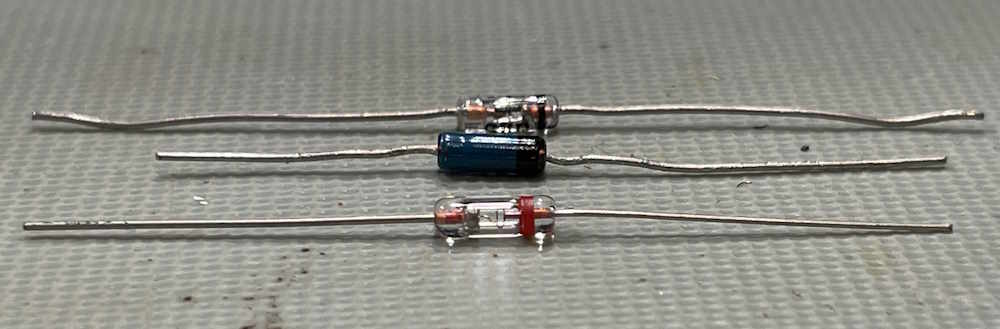
I’m going to test these parts. We have, from top to bottom:
A traditional 1N34A glass diode.
An unknown germanium - this may be a 1N60.
A Soviet type D9A.
All of them have well denoted bands. I’m going to toss in a 1N4007 Si rectifier diode (not shown) as well, just for comparison.
Here’s the parts as viewed through a magnifying glass. Of particular note is the Soviet part - you can clearly see the flying lead and the point of contact on the germanium crystal.
1N34A
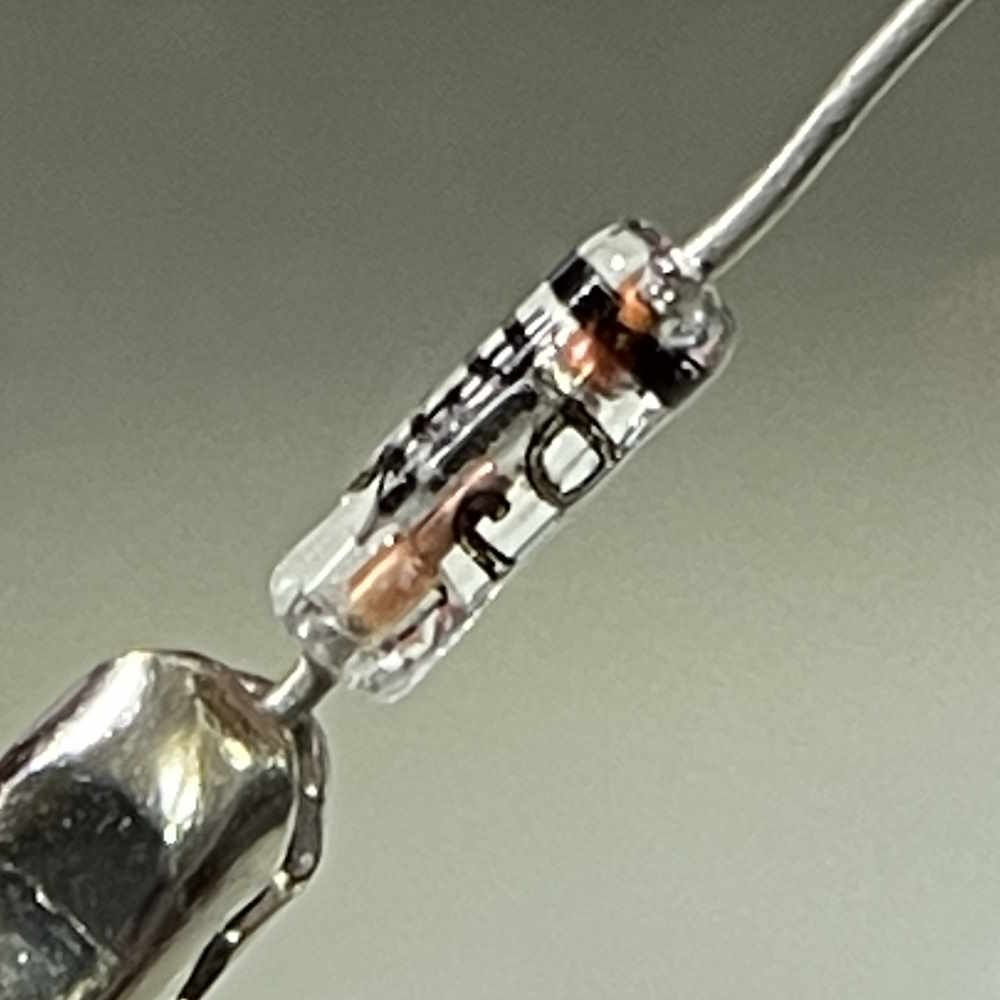
Unknown germanium
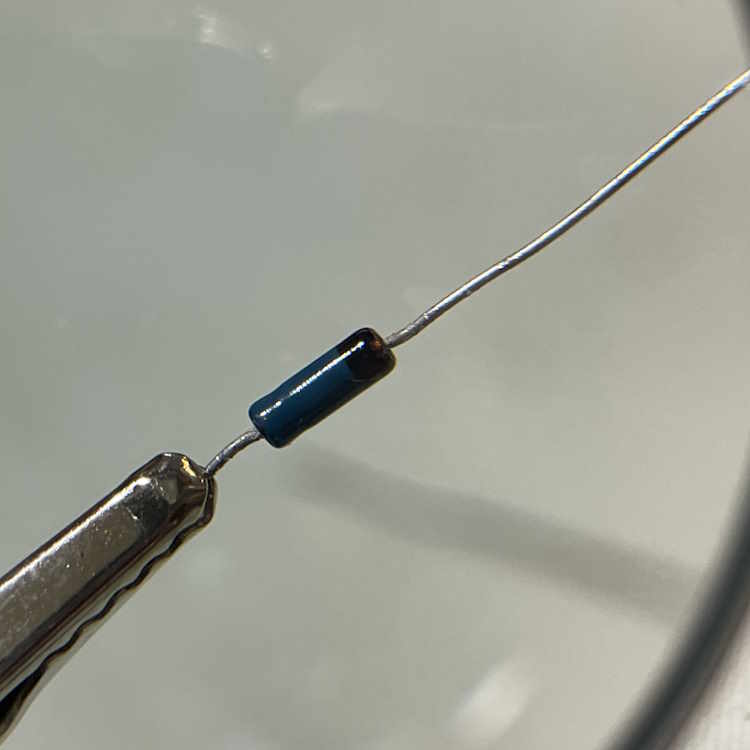
Soviet D9A

Testing the diodes
What’s the purpose here? Well…the Soviet part has something interesting about it. If you’re familiar with how the diode works, you’ve already noted the issue.
Let’s test the parts, I’m going to be using my old reliable, a meter I purchased many many years ago. It has a diode function that tells you the voltage drop across the diode’s junction.
For diodes, these are the “perfect” theoretical voltage drops across a junction:
Silicon: 0.7VDC
Germanium: 0.3VDC
In reality, it’s closer to 0.5VDC and 0.23VDC, respectively. Let’s test the parts on the bench. First one is the silicon diode, for comparison.
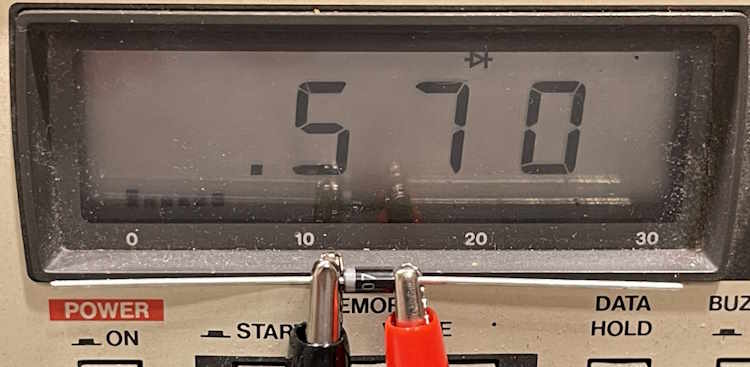
Note the negative lead of the meter is on the banded side of the diode, so we know that’s the cathode. We see the expected 0.5xxVDC drop of the junction.
Here’s the 1N34A:
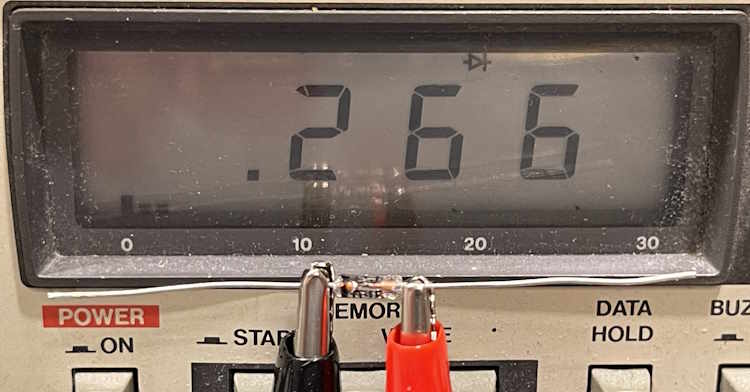
That’s in line with the expected drop.
Here’s the unknown germanium:
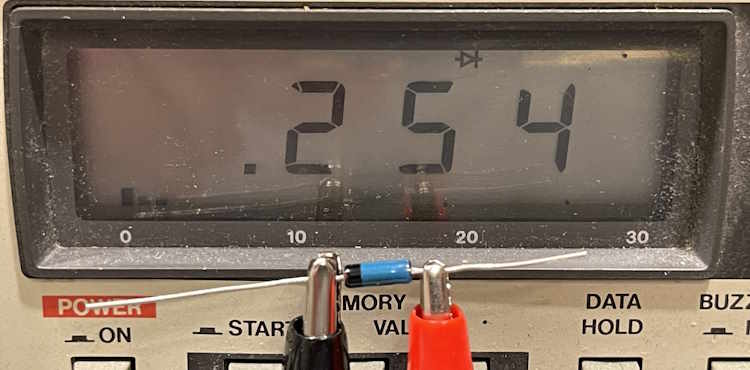
Again, the expected drop.
Here’s the Soviet D9A:
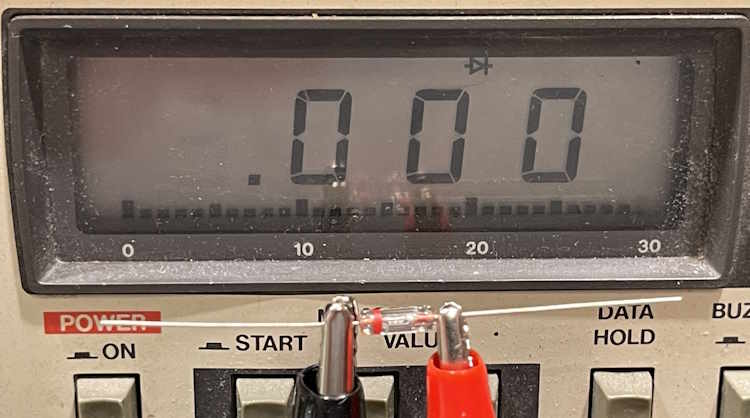
It’s correct, that’s zero. There’s no drop across this device, indicating the unit isn’t conducting. It’s connected correctly, isn’t it?
No - Soviet diodes put their bands on the anode. That is, they are marked completely backwards from what we accept as diode marking. Here’s the device properly biased:
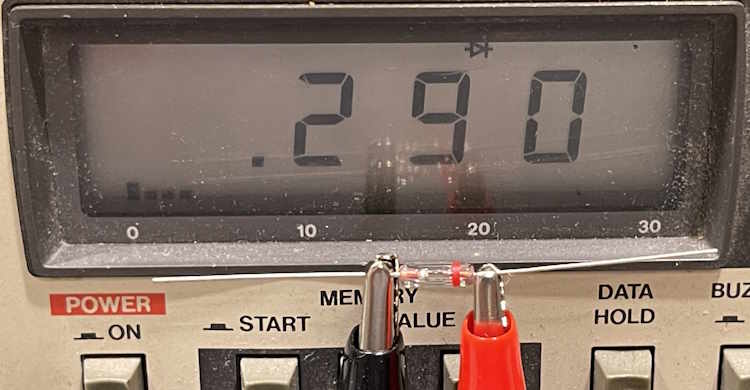
There’s the expected drop. Completely backwards from what we expected.
Why is this important?
Soviet germanium diodes are the most common Ge diode available at this time, so they show up in a lot of places. Radio kits, fuzz boxes for guitars, small signal rectification circuits - anywhere a diode with it’s properties are needed. For a radio kit, it’s not really terribly important which side of the information you recover from the carrier, but if you’re trying to rectify a signal it’s very important. You need to make sure you install them correctly, and if you follow “accepted” conventions you’re not going to accomplish that goal.
Measure your part - that’s the best way to verify what you have.